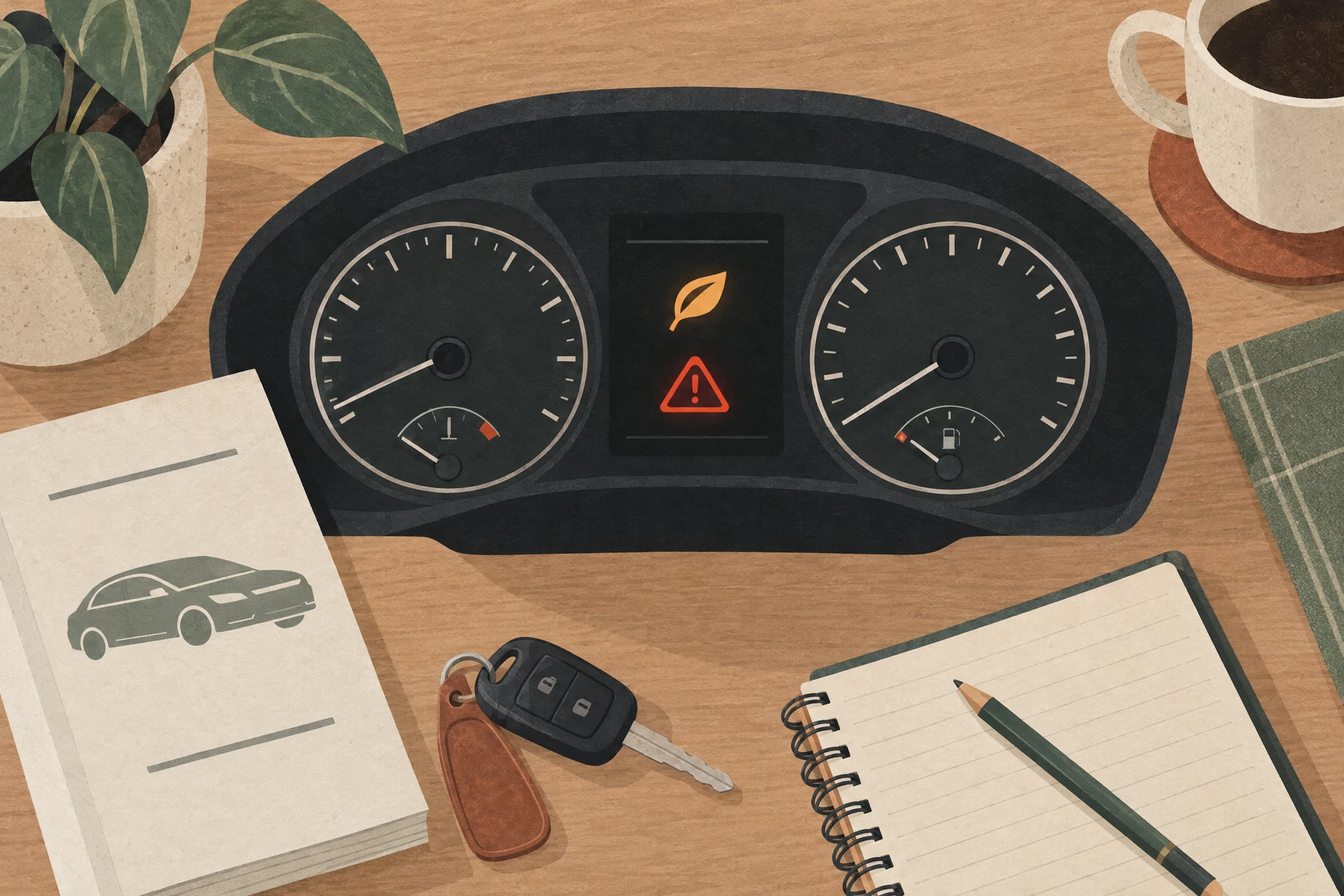
What to Write Down When a Dashboard Light Appears
A simple record of color, timing, vehicle behavior, and recent context can make an unfamiliar alert easier to discuss.
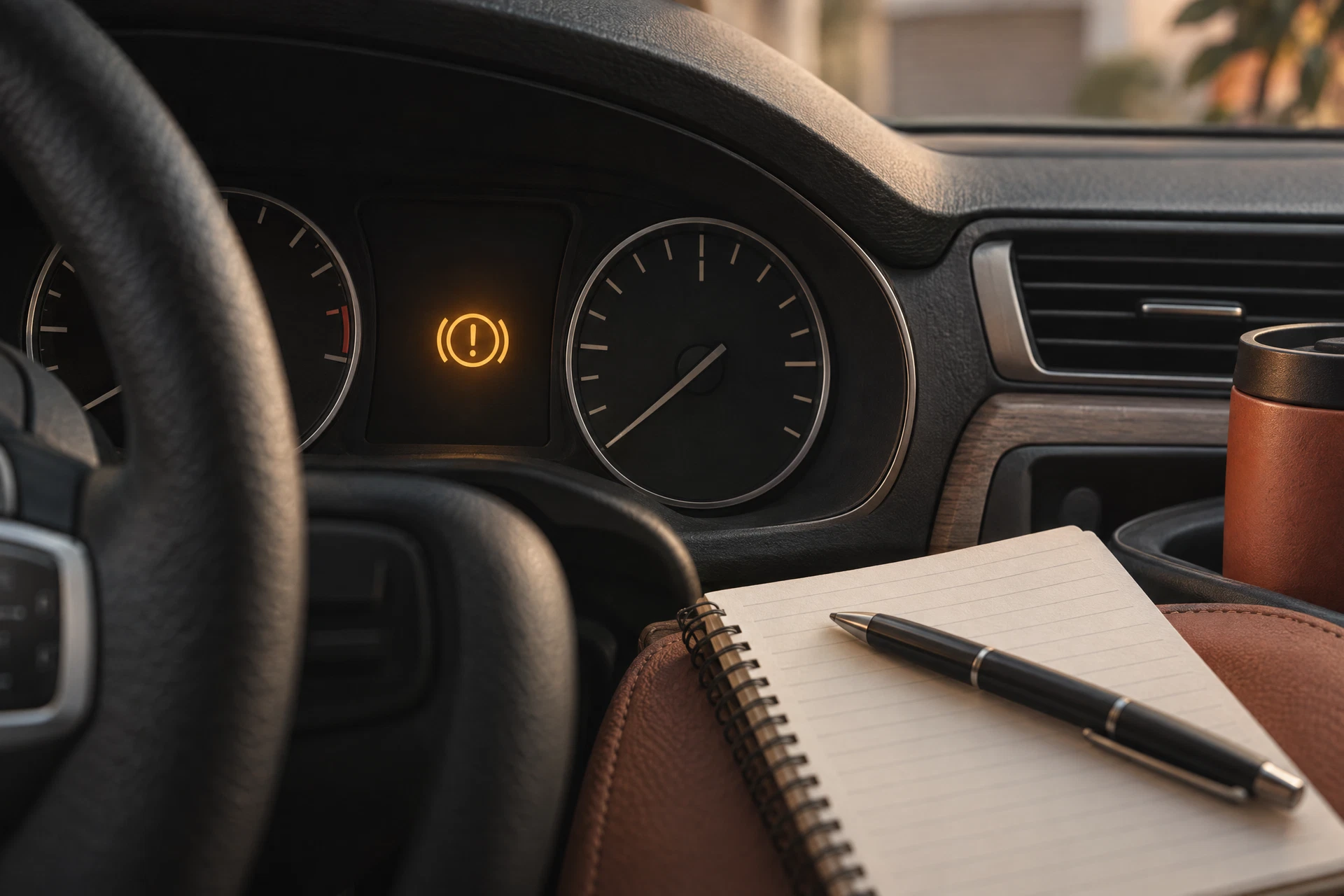
When a dashboard light appears, the first useful thing to do is stop and record what you can observe. Clear, specific notes and images taken at the moment make it easier to explain the situation to a technician later and can shorten the time it takes to identify the issue. Keep a pen and a phone-ready template in your glovebox or a note-taking app so you can capture the detail without guessing later.
Focus on facts you can verify: the exact symbol or text that lit up, what color and whether it is steady or flashing, what the gauges and other displays are doing, the time and mileage, and any immediate changes in the way the vehicle behaved. Red/flashing alerts, sudden/persistent behavior changes, or uncertainty about safe travel should be evaluated promptly by a qualified professional. If you are unsure whether it is safe to continue driving, stop in a safe place and seek help rather than pressing on.
Good notes are short, precise, and paired with media. Take a photo of the instrument cluster that clearly shows the active warning, record a 10–20 second video of the dashboard while you reproduce the symptom if it’s safe to do so, and write the small facts that photos don’t capture: rewindable sequence, smells, sounds, and actions you took. Use the owner’s manual to identify icons but still capture what you personally saw — technicians rely on firsthand details as much as codes.
In this article
Name what you can see
Start by naming the light exactly as it appears. Is the icon a triangle with an exclamation point, an engine outline, a thermometer, or a worded message such as “CHECK ENGINE” or “LOW OIL”? Note the literal text if there is any. Describe the color (amber/amber-yellow, red, green, blue) and whether the lamp is steady, blinking, or pulsing. If the instrument cluster shows a separate message line or a symbol accompanied by a line of text, copy that text word-for-word.
Record where on the dash cluster the light sits — left, center, right, or within a digital display — and whether multiple indicators are visible at once. Note any gauge readings beside the light: exact temperature gauge position, fuel level fraction, or battery voltage icon state. If the light is accompanied by additional symbols (for example, a wrench, padlock, or directional arrow), list those too. Take a close-up photograph so the technician can see icon shape, color hue, and any tiny letters you might miss when describing it.
Put the moment on a timeline
Anchor the event with when and where. Write the exact time, the odometer reading, and trip mileage when the light first appeared. Note whether the vehicle was warming up, idling, cruising at highway speed, accelerating, braking, or sitting in traffic. Record if the light came on immediately after a hard event (steep hill, heavy towing, stop-and-go traffic, recent cold start) and how many miles or minutes elapsed before you noticed it.
Add a short sequence of what happened next: did you pull over, restart the engine, turn accessories off, or try to clear the light? Record how long the light stayed on and whether it reappeared after an engine restart or after driving a particular distance. Also include recent contextual events that could be relevant — fuel fill-ups (time, place, grade), recent service or part replacements, jump-starts, or impacts — with dates and mileage so a technician can correlate them.
Describe behavior without diagnosing
Use observational language only; avoid naming causes. Instead of writing “bad alternator,” describe exactly what you felt and heard: “dash lights dimmed while accelerating from 40–55 mph, radio volume dropped, dashboard fan speed stayed constant, faint belt squeal for 10 seconds.” Note whether the engine lost power, stumbled, misfired, made knocking noises, or ran normally with only the light on. Be specific about timing — whether a symptom is continuous, intermittent, or occurs at certain RPM ranges or speeds.
Ask concrete, answerable questions and write the answers: Did the steering pull to one side? Were ABS pulses felt under braking? Was there a new smell (burnt, fuel, coolant) and where did it seem to come from (engine bay, footwell, rear)? Did any other lights illuminate before or after (ABS, traction control, battery)? If you tried anything — reduced speed, turned off the air conditioning, idled for several minutes — note what you tried and whether it changed the light or the behavior. This lets a technician test the same scenarios without leaping to a conclusion.
Bring the right record forward
When you take the vehicle to a technician, bring a concise packet of the facts you collected: a short, ordered timeline (one page), photos and videos of the dashboard and any warning messages, the odometer and VIN (or a photo of the registration), and any recent service invoices or receipts. If you used an OBD-II scanner and captured fault codes, print or screenshot those readouts and the time you recorded them. Include a copy of the owner’s manual page for the symbol if you looked it up; it helps the technician confirm whether the light’s meaning matches the vehicle’s display.
Organize the information so the first items answer the technician’s immediate questions: What did you see first? What did the car do next? What did you try? Highlight any red or flashing lights and the precise steps that reproduced the symptom. Keep the original media files on your phone and email a copy to yourself before going in, so you can hand over a printed timeline while the technician views the photos or video. These steps reduce back-and-forth and let the professional focus on inspection and testing.
Keep the next step useful
Clear, factual notes and simple media make a real difference in getting accurate attention from a technician. Use the owner’s manual to confirm symbols, avoid guessing causes in your notes, and take the records with you when you seek help. If a warning light is red or flashing, a sudden or persistent change in vehicle behavior occurs, or you are unsure whether it is safe to continue driving, have the vehicle evaluated promptly by a qualified professional.