How to Talk About a New Vehicle Noise Without Guessing
A plain-language method for recording when a sound occurs, what changes it, and what context a qualified professional may need.

A new or unexpected noise from your vehicle can feel unsettling, but the first priority is to describe it clearly rather than to guess its cause. Clear, simple language helps you communicate the symptom to a technician, a service writer, or even a friend who’s trying to help you decide whether you can drive the vehicle home. Start by slowing down your own interpretation — focus on observable facts about the sound instead of naming parts or mechanisms you don’t know for sure.
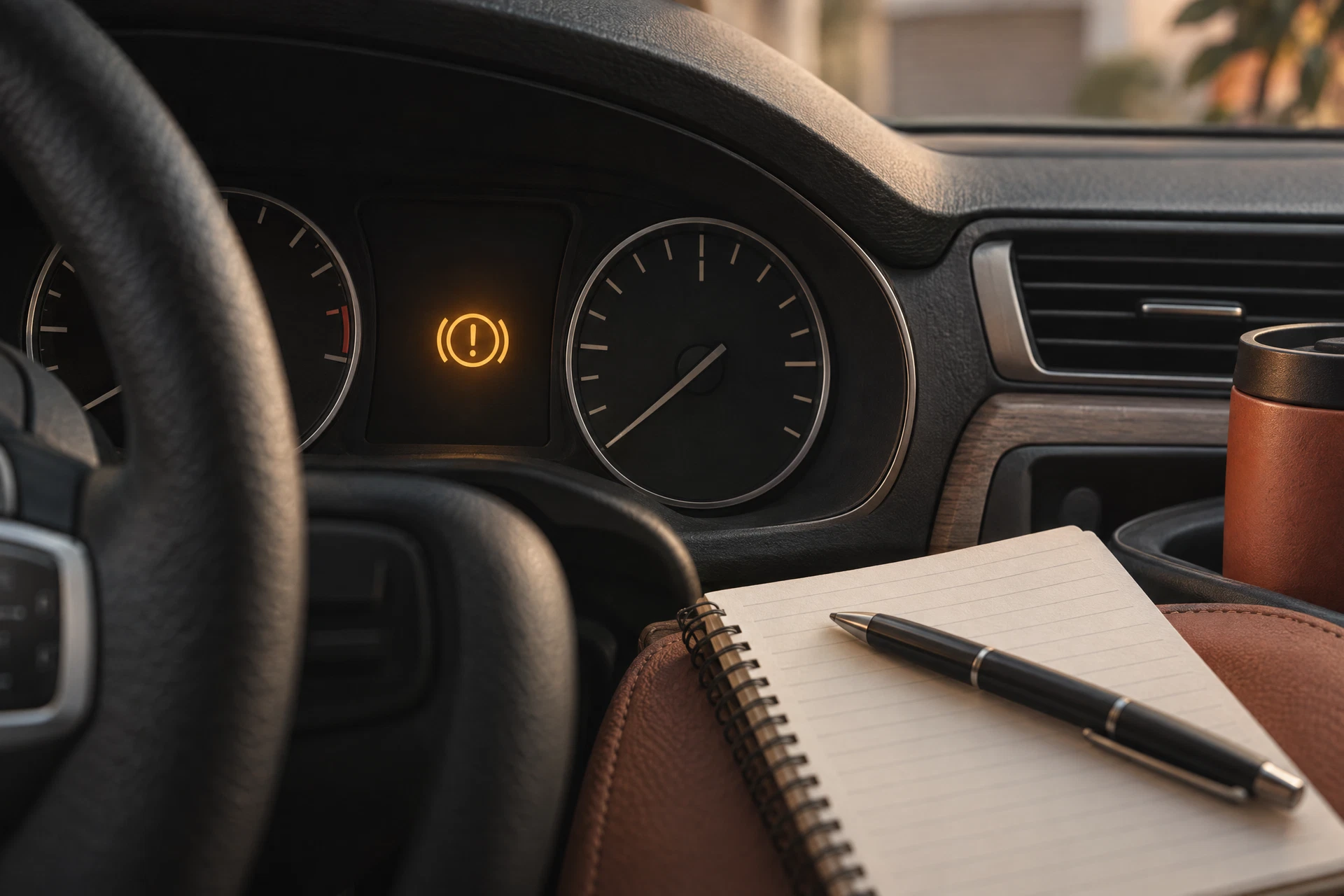
For warning-light, braking, temperature, tire, or driving-safety contexts, red/flashing alerts, sudden/persistent behavior changes, or uncertainty about safe travel should be evaluated promptly by a qualified professional. If any of those conditions apply, consider stopping in a safe place and arranging for professional inspection rather than continuing to drive. When the situation feels nonurgent, you still want to gather useful details so a trained person can quickly orient themselves to the problem.
The three practices below — using simple comparison words, tying the sound to measurable conditions, and adding other observations — form a short checklist you can use at the roadside or before you call for help. If it’s safe to do so, a short recording can be very helpful; include context with that clip so someone listening later knows what you were doing when the noise happened.
In this article
Choose simple comparison words
Pick two or three plain words that capture the character of the noise and avoid part names or technical diagnoses. Good descriptive anchors include: ticking, clicking, pinging, clunking, grinding, rubbing, whining, humming, buzzing, squeal, or rattle. You can add a modifier like “high” or “low,” “fast” or “slow,” or “intermittent” or “constant” to narrow the description (for example: “high-pitched intermittent squeal”).
If it helps, compare the noise to familiar household sounds so the person you’re talking to has a reference: a ticking like a kitchen timer, a popping like a popcorn kernel, a metallic ping like a dropped coin, or a low growl like a refrigerator. Those comparisons should support the simple descriptors rather than replace them — say “metallic ping, like a coin dropped on tile, happening once per wheel rotation at about 40 mph,” not “sounds like a bad bearing.” That keeps your report factual and useful.
Tie the sound to a condition
Note exactly when the noise occurs: during acceleration, during deceleration, only at steady speed, only when idling, when turning the steering wheel, when going over bumps, or when a particular gear is engaged. Ask yourself specific questions and answer them: Does the noise change with vehicle speed or engine RPM? Does it start only after the engine is warm or only while cold? Does it happen only when the vehicle is loaded or towing?
Also record whether the noise is linked to a specific control action: is it present only when braking, when turning left but not right, only when the cruise control is engaged, or only when the transmission is in drive versus neutral? Saying “occurs only above 45 mph and increases in frequency with speed” or “starts within 30 seconds of cold start and stops once warmed up” gives a technician immediate clues about likely operating conditions without you having to identify the failing component.
Add other observations
Supplement the sound description with nearby sensations and visible signs. Note whether you can feel a vibration in the steering wheel, seat, or pedals when the noise occurs; whether a new smell is present; whether there is visible fluid under the vehicle; or whether the vehicle pulls to one side. Even if you aren’t sure a symptom is related, mention it: technicians can rule connections out quickly when they have more information.
Write down the sequence of events as you noticed them: when you first heard the noise, what you did next, how it changed (if at all) over several starts or drives, and whether any dashboard lights came on. Keep the account short and factual: for example, “First heard on June 4 at 9:15 a.m.; only during right turns at low speed; no dashboard lights; no fluid on driveway; slight vibration in left footrest during the noise.” That list format is easy to read and transfers readily into service records.
Bring a short recording if safe
A short audio clip can be worth more than a long description, but only create one if it’s safe to do so. If you’re stopped in a safe place, set a phone on a stable surface, record 10–30 seconds while reproducing the condition (for example, revving in neutral, turning the wheel, or coasting at the speed where the noise appears), and label the file with the conditions present: speed, gear, engine temperature, and any controls you used.
If recording while driving would be unsafe, have a passenger make the clip or recreate the condition in a parking lot at low speed. Avoid holding the phone while driving. When you deliver the recording to a shop, attach a one-sentence summary of where and when the clip was made and list the key observations that accompanied the sound. That combination — short labeled clip plus concise notes — helps a technician focus their inspection efficiently without you attempting to diagnose the underlying cause.
Keep the next step useful
Describing a new vehicle noise doesn’t require technical vocabulary — it requires clear, repeatable facts and safe behavior. Use simple comparison words, tie the sound to measurable conditions, add supporting observations, and, when it’s safe, bring a short recording labeled with context. Always consult your owner’s manual for vehicle-specific guidance and seek a qualified professional to evaluate red or flashing alerts, sudden or persistent changes, or any uncertainty about whether it’s safe to continue driving.